Forex Leverage Explained: What Beginners Need to Know
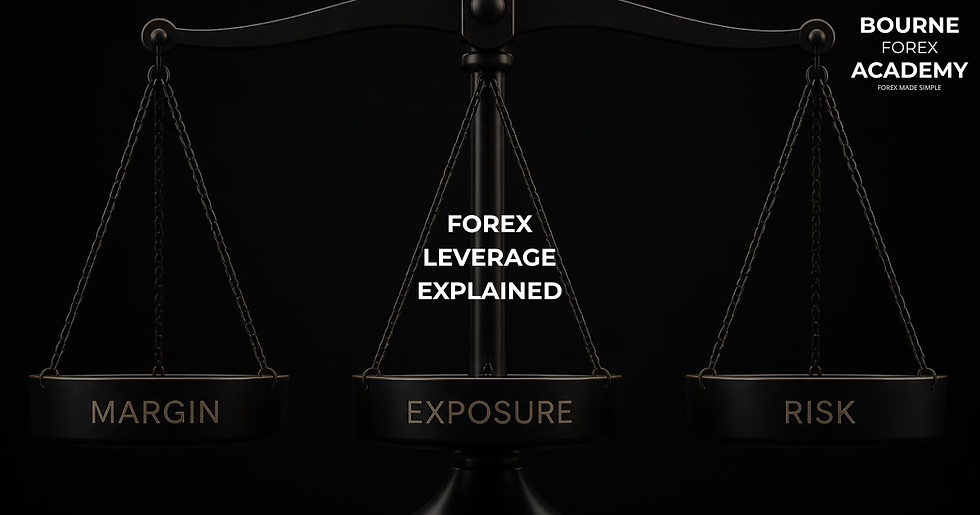
Leverage is one of the most misunderstood parts of forex trading.
It is often presented as a benefit because it allows a trader to control a larger position with a smaller amount of money.
That is true.
But it is only half the story.
Leverage also increases the financial impact of price movement. A small move in the market can create a much larger gain or loss relative to the money committed to the trade.
This is why leverage should be treated carefully.
It does not improve a trade idea. It does not make a strategy more reliable. And it does not remove the need for risk management.
What is leverage?
Leverage allows you to control a larger market position than the amount of money you need to deposit as margin.
For example, leverage of 10:1 means that, in simple terms, £1 of margin can control £10 of market exposure.
Leverage of 30:1 means £1 of margin can control £30 of exposure.
The exact amount available will depend on the product, the broker, the currency pair and the regulations that apply to you.
But the principle remains the same:
Leverage increases exposure. It does not reduce risk.
A trader may only need a relatively small amount of margin to open a position. But the profit or loss is based on the full position size, not simply on the margin deposited.
Margin is not the same as risk
Margin is the amount required to open and maintain a leveraged position.
Risk is the amount you could lose if the trade moves against you.
These are not the same thing.
A low margin requirement can make a large position appear affordable. But affordability at the point of entry does not mean the position is sensible.
For example, a broker may allow you to open a large trade with a small amount of margin. If the market moves against that position, the loss can still become significant very quickly.
This is why it is dangerous to choose trade size based on the amount of margin available.
Your risk should be based on:
The point where the trade idea is invalidated
The distance to that point in pips
The value of each pip at your chosen position size
The amount you are prepared to lose if the idea is wrong
Margin is a platform requirement. Risk is a decision you need to make before entering a trade.
Why leverage can make losses happen faster
Imagine two traders looking at the same market.
Both take the same direction. Both use the same entry and the same stop loss. The market moves against them by the same number of pips.
The difference is position size.
One trader uses a smaller position. The other uses a much larger position because leverage makes it available.
The market has moved exactly the same distance for both traders. But the second trader experiences a much larger financial loss because each pip is worth more to their position.
This is the risk of leverage.
It can make normal market movement feel emotionally overwhelming. It can encourage a trader to close a position too early, move a stop loss or take decisions based on fear rather than process.
Leverage does not cause poor decisions on its own. But it can magnify the consequences of poor position sizing.
More leverage does not mean more opportunity
A common mistake is to assume that higher leverage creates a better chance of success.
It does not.
Leverage gives you access to a larger position. It does not improve your ability to read the market, manage a trade or control emotion.
A poor trade idea remains a poor trade idea, regardless of how much leverage is available.
In fact, access to excessive leverage can make it harder for beginners to learn because every small movement starts to feel important.
Good trading is not about using the maximum amount available.
It is about using an amount that allows you to follow your process without one normal loss becoming damaging.
A simple way to think about leverage
Think of leverage as a tool that makes the position larger.
That is all.
Do not think of it as extra money, a shortcut to greater returns or a reason to take more risk.
Before you use leverage, ask:
What is the full size of the position I am controlling?
How much is one pip worth at this size?
Where is my stop loss?
What is the maximum loss if the stop loss is reached?
Can I genuinely afford and accept that loss?
If you cannot answer those questions clearly, the position is too complicated or too large for you.
Leverage and position sizing work together
Position sizing and leverage are closely connected, but they are not the same thing.
Position sizing is the decision about how much market exposure fits your risk.
Leverage is the mechanism that may allow you to control that exposure with less margin.
The correct order is:
Identify where the trade idea would be wrong.
Measure the distance to that point.
Decide how much you are prepared to risk.
Choose a position size that fits that risk.
Check the margin requirement and make sure you understand it.
The mistake is starting at step five.
Available margin should never decide how much you risk.
Why retail protections matter
In the UK, retail protections apply to certain leveraged products, including CFDs and rolling spot forex offered by regulated firms.
These protections can include leverage limits and measures intended to reduce the risk of retail clients losing more than the money held in their trading account.
Those protections are important. They are not a reason to become careless with risk.
A regulated broker, leverage limit or platform warning cannot replace your own judgement. You still need a clear process, appropriate position size and a realistic understanding of what can happen when markets move quickly.
Always check the regulatory status of a broker and understand the specific product you are using.
The beginner mistake to avoid
The biggest leverage mistake is simple:
Using the largest position a broker allows instead of the smallest position that fits your risk.
The broker does not know your financial circumstances, experience or ability to manage a loss.
Only you can decide whether the amount at risk is appropriate.
If a normal price movement can cause panic, force you to watch every tick or make you want to break your rules, the position is probably too large.
Smaller exposure may feel less exciting. It also gives you more room to learn properly.
The main lesson
Leverage is neither good nor bad on its own.
It is a tool.
Used without understanding, it can create large losses quickly. Used with a disciplined risk process, it is simply part of how some forex products work.
The important thing is not how much leverage is available.
The important thing is how much risk you are taking.
What to learn next
Once you understand leverage, the next step is learning about the costs involved in opening and holding a forex position.
Read next: Forex Spreads and Commissions Explained
You may also find these useful:
Forex Lots and Position Sizing Explained
What Are Pips in Forex? A Beginner Explanation
Risk warning: Forex and leveraged products carry a high level of risk and may not be suitable for everyone. This article is for general educational purposes only and is not personal investment advice. Never trade with money you cannot afford to lose.


Comments